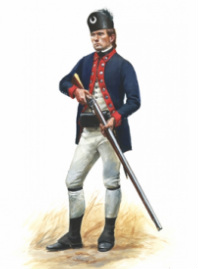
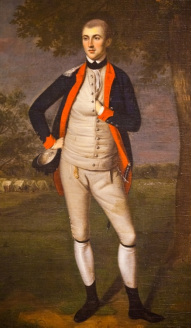
As with most American units, the uniform of the Second Regiment changed dramatically over the course of the war. We have chosen to represent the regiment as it appeared in mid-1777. Our uniform and equipment is based upon extensive research in primary documentation, including order books, state accounts, private papers, and period paintings. Even so, our research remains a work-in-progress. In the coming months, this page will include more extensive discussion and documentation of the 2nd Regiment's clothing and equipment, plus more specific information on where to obtain the appropriate items.
Get in Gear The following article(s) are written by and for reenactors as pertaining to the selection and procurement of gear and clothing for the correct imopression of this regiment.
If you are joining the regiment, please contact a unit leader before acquiring any clothing or equipment. This will save you time, money, and trouble!
Clothing Items
Cap: Black leather helmet with front shield and blue wool turban. "LIBERTY" crescent on shield.
Neck stock: Black Leather neck stock as specified in the order book.
Regimental Coat: Dark blue wool with scarlet cuffs, cape, lapels, and lining. Cuffs are scalloped. Coat is cut very close. Narrow lapels with 11 pewter buttons on each side, including one securing each side of the cape. False pockets with four buttons on each flap. Arabic "2" on buttons.
Hunting Shirt: Split-front over shirt (frock) made of unbleached linen, with large single cape and small fringe.
Waistcoat: White linen waistcoat, cut straight across in front (not V-cut), with 14 plain pewter buttons. Has two small pockets with straight-cut flap.
Shirt: White 18th-century drop-sleeve shirt, made of linen or cotton.
Breeches: White linen drop-front breeches. Five pewter buttons on each leg. Buttons below knee
Stockings: Cotton or wool stockings. White is preferred, though other "modest" colors may be acceptable.
Garters: Black leather garters with buckle.
Half-Gaiters: Also called "spatterdashes". Black linen or cotton duck, blacked with shoe polish or blackball. Seven buttons on each, sewn-on leather strap to attach under shoe sole.
Shoes: 18th-century black leather low quarters, buckle-type preferred
Civilian Dress: The acquisition of period civilian clothing is desirable for the events at which we portray militia, but this is a secondary priority.
Please see the following picture pages to see the items described here and how they should be worn. Both clothing and equipment items are shown in these pictures.
EQUIPMENT
Bayonet Carriage (# 3): Shoulder carriage, made of buff leather but polished white.
Cartridge Box (# 4): French pattern, made of leather with buff-polished-white carriage.
Haversack (# 5): Natural linen sack with three buttons and linen shoulder strap.
Canteen (# 6): Wood (1st choice) or tin.
Bayonet (# 1): Appropriate type for Charleville or Bess, with frog and black leather scabbard
Blanket (# 8): Woolen blankets appropriate for period. Best to have at least two (one lighter, one heavier).
Ground Cloth (# 13): Heavy Canvas, painted until waterproof.
Soldier's Kit:
Musket Cleaning Kit (musket tool, worm, oil)
Plate or bowl (wood or tin) (# 12)
Tin cup (# 9)
Eating utensils (knife, 2-prong fork, spoon) (# 10)
Personal Items (toiletries, money, books, writing materials, pocket knife, etc.) (# 11)
Musket: Both are smoothbore flintlocks. (click on the musket name for images of that particular musket)
Knapsack (# 7): French pattern but made of cotton duck, painted red for waterproofing.